How Under Armour Targets Sub-3-Second Loads — Across 35 Global Storefronts on Fastly
Every CDN, platform decision, and PWA migration behind underarmour.com — and how a headless SFCC rebuild drove 16% higher conversions.
(per Merkle)
on headless SFCC
from PWA migration
(DNS verified)
First: Why Should You Care About Under Armour's Site Speed?
Hard revenue data from Google, Portent, and Deloitte that proves speed is money
Under Armour is a $5.2 billion company (FY2025 revenue, per SEC filings) running 35 global storefronts. When your ecommerce operation spans three continents, every millisecond of load time multiplies across millions of sessions. Speed isn't a vanity metric at this scale — it's revenue infrastructure.
Sites loading in 1 second have 5x higher conversion rates than sites loading in 10 seconds. Not 5% more. Five times more.
Bounce rate increases 90% when load time goes from 1 second to 5 seconds. Nine out of ten people who would've stayed on your site just... leave.
A 0.1-second improvement in mobile speed = 8.4% more conversions in retail ecommerce. That's not a typo. One tenth of a second. Google and Deloitte measured this across real retail sites.
Under Armour gets this. That's why they invested in rebuilding their entire ecommerce platform — migrating from a legacy homebuilt system to headless Salesforce Commerce Cloud, then layering on a PWA for mobile. Let's look at what they built.
Speed gets visitors to the page. But do you know who they are? LeadMaxxing identifies your anonymous visitors and scores them so you know which ones are worth chasing.
Core Web Vitals: The 3 Numbers Google Actually Uses to Rank You
LCP, INP, and CLS explained — and how to check Under Armour's real scores yourself
Google doesn't care about your Lighthouse score. Seriously. Lighthouse is a lab test — it's a simulation. What Google actually uses for rankings are Core Web Vitals: real data from real Chrome users visiting your real site over the last 28 days. Three numbers:
| Metric | Plain English | Good | Bad | Why It Matters |
|---|---|---|---|---|
| LCP | How fast the main content appears | < 2.5s | > 4.0s | Users see a blank screen until LCP fires. Slow LCP = they leave before seeing your product. |
| INP | How fast buttons & clicks respond | < 200ms | > 500ms | When "Add to Cart" feels laggy, people don't add to cart. |
| CLS | How much the page jumps around | < 0.1 | > 0.25 | Ever try to tap a button and the page shifts so you hit the wrong thing? That's CLS. Users hate it. |
Users are 24% less likely to abandon a page when it passes all three. That's the difference between a $1M/year store and a $1.24M/year store — from metrics alone. Core Web Vitals are also a confirmed SEO ranking signal, which means slow sites lose twice: visitors leave AND Google ranks you lower.
Run a live PageSpeed test on underarmour.com right now → — you'll see their real CrUX field data.
Think of it like a restaurant. LCP is how fast the food arrives. INP is how quickly the waiter responds when you flag them down. CLS is whether your plate slides off the table while you're eating. Google measures all three for every visitor, and if your site fails, it ranks lower. Period.
The Platform Migration That Changed Everything
How Under Armour went from legacy homebuilt to headless SFCC across 35 storefronts
Under Armour's ecommerce evolution is a story of three migrations. They started on a homebuilt commerce platform. As the business scaled to billions in revenue and expanded globally, that system couldn't keep up. So they made the call to move to Salesforce Commerce Cloud (formerly Demandware), partnering with Merkle for the implementation.
But SFCC alone wasn't fast enough. In 2023, Under Armour set an ambitious goal: consistently hit sub-3-second page load times. That's hard for any commerce site, but especially one running 35 storefronts across three regions with dynamic content, personalization, and localization on every page. Merkle helped move the SFCC implementation to a headless front end — decoupling the storefront from the commerce backend entirely.
What "Headless" Means (Without the Jargon)
Normal ecommerce setup: One system builds your page AND handles your payments AND manages your products. It does everything. But when millions of shoppers show up on Black Friday, "everything" becomes "nothing" because it all falls over together.
Under Armour's headless setup: SFCC ONLY handles product data, inventory, and checkout. A completely separate frontend builds the actual pages customers see. The two talk through APIs. If the frontend gets slammed with traffic, checkout keeps working. If checkout hiccups, the frontend keeps showing products. (We break down their full tech stack and security configuration in a separate report.)
The result? Per Merkle's case study, Under Armour now runs "one of the most performant ecommerce sites on the web" — a headless SFCC build spanning 35 global storefronts with sub-3-second page load targets.
Probably not. Headless makes sense when you're operating at Under Armour's scale — $5B+ in revenue, 35 global storefronts, three regions. If you're under $10M, a well-optimized Shopify theme or standard SFCC storefront gives you 90% of the benefit at 10% of the cost. The real wins are usually simpler: compress images, defer scripts, pick a fast CDN.
The PWA Migration: +16% Conversions, +14% Revenue Per User
Per Astound Digital's published case study, the UK PWA pilot results drove a global rollout
Under Armour didn't stop at headless. They partnered with Astound Digital (formerly Mobify) to migrate their UK site from a responsive design to a Progressive Web App (PWA). The goal was clear: faster mobile page loads that translate directly to higher conversions and revenue.
Source: Astound Digital case study. These figures represent the UK PWA pilot results.
The 65% drop in pre-bounce rates is the headline stat. "Pre-bounce" means users who leave before the page even finishes loading. A 65% reduction means the PWA loaded fast enough that nearly two-thirds of those would-be bouncers stuck around long enough to see the page. More eyeballs on products = more conversions. Simple math.
With those results, Under Armour greenlighted a global PWA rollout. The UK was the test case. When a 16% conversion lift proves out in one market, you roll it everywhere. That's the power of investing in speed: the ROI compounds across every market, every storefront, every session.
A PWA loads like a native app. It pre-caches critical assets, works with flaky connections, and renders instantly on return visits. For Under Armour, this meant mobile shoppers got a near-instant experience instead of waiting for a full-page download on every tap. At their scale, even the 14% revenue-per-user improvement translates to significant incremental revenue. Curious what their ad strategy drives to these faster landing pages?
Under Armour needed separate vendors for speed optimization, PWA development, and analytics. LeadMaxxing combines visitor tracking, lead scoring, and conversion analytics in one lightweight script — so you don't need to stack tools and tank your PageSpeed.
Fastly CDN + Security Headers: The Infrastructure Layer
DNS-verified CDN configuration and the security headers Under Armour is missing
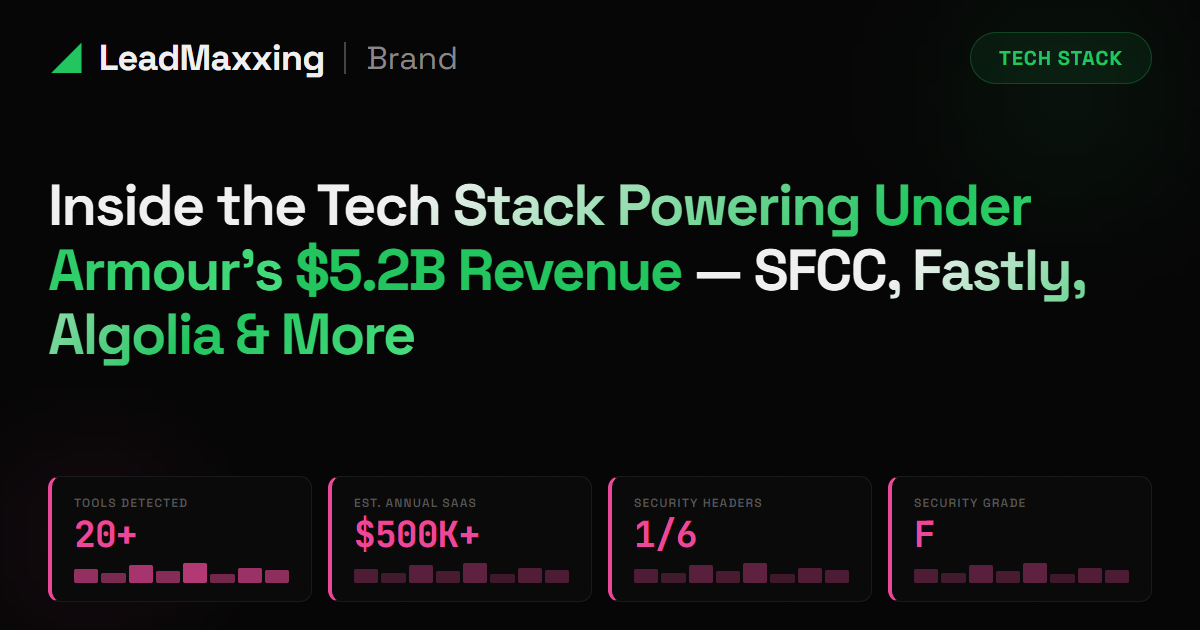
Under Armour runs on Fastly CDN. DNS analysis confirms their domain resolves via a CNAME to n.sni.global.fastly.net with four A records pointing to Fastly edge servers in the 151.101.x.91 range. Fastly's network uses fewer but more powerful points of presence than competitors, with instant cache purging that lets Under Armour update pricing and inventory across 35 storefronts in real time. (See our tracking and privacy audit for the complete picture of what runs on each pageview.)
Security Headers: Room for Improvement
Under Armour scores an F grade on security headers — with only 1 of 6 recommended headers present. While security headers don't directly impact page speed, they affect overall site trustworthiness and can prevent performance-degrading attacks like clickjacking and MIME-type confusion.
Missing CSP is the one that matters most for performance. Without a Content-Security-Policy, any script injected by a compromised ad network or browser extension runs unchecked. CSP acts as a whitelist for what can execute on your pages. For a brand handling payment data across 35 storefronts, implementing CSP would both strengthen security and prevent unauthorized scripts from degrading page speed.
Key Findings
- → Under Armour targets sub-3-second page loads across 35 global Salesforce Commerce Cloud storefronts, per Merkle's published case study
- → Their PWA migration drove +16% conversions and +14% revenue per user on the UK pilot, per Astound Digital — results that triggered a global rollout
- → Fastly CDN serves all traffic via edge caching (DNS-verified: CNAME to n.sni.global.fastly.net with 4 A records in the 151.101.x.91 range)
- → Security headers score F with only HSTS present (1/6) — missing CSP, X-Frame-Options, X-Content-Type-Options, Referrer-Policy, and Permissions-Policy
- → Under Armour reported $5.16 billion in FY2025 revenue (SEC filing) with ecommerce representing a mid-teen percentage of global revenue and ~40% of their DTC business
What This Data Means for You
Turning Under Armour's site speed strategy into your competitive advantage
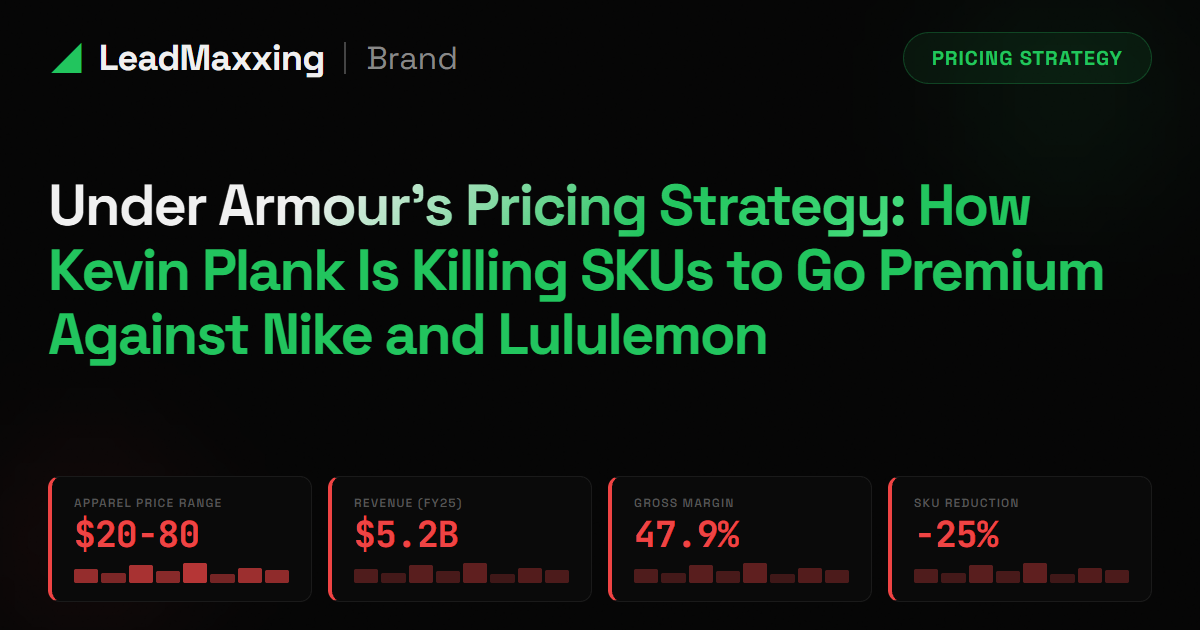
Under Armour's speed story proves that platform migration pays for itself. Their PWA pilot delivered a 16% conversion lift in a single market — then scaled globally. You don't need 35 storefronts or a $5B revenue base to benefit from the same principles. The biggest wins are basics: a fast CDN, image optimization, deferred third-party scripts, and monitoring real user data via Core Web Vitals. Study how they handle pricing across markets and what their email and CRM strategy looks like to understand the full picture of their ecommerce operation.
LeadMaxxing Automates This Speed-to-Revenue Playbook
Under Armour uses multiple vendors for analytics, personalization, and conversion tracking. LeadMaxxing gives you AI-powered visitor identification, lead scoring, and automated email campaigns for $29/month — the same conversion intelligence without the enterprise price tag or the PageSpeed hit from stacking scripts.
See how it works →5 Things You Can Implement Today
Actionable lessons from Under Armour's site speed playbook
You don't need Under Armour's budget. Here's the 20% of effort that gets you 80% of their speed:
Run PageSpeed Insights on Your Key Landing Pages
Takes 5 minutes. Go to PageSpeed Insights and test your homepage, top product page, and cart page. The "Opportunities" section tells you exactly what to fix. This is especially critical for paid ad landing pages where every fraction of a second impacts ROAS. LeadMaxxing automates competitor speed tracking so you always know where you stand.
Put a CDN in Front of Everything
Takes 1 hour. Under Armour uses Fastly. Cloudflare offers a free tier that gets you 80% of the benefit. A CDN caches your pages at edge servers worldwide — so a shopper in London loads from London, not from your origin server in Virginia. LeadMaxxing monitors your infrastructure alongside conversion data so you can correlate speed changes with revenue impact.
Defer Every Third-Party Script You Can
Takes 1 day. Open Chrome DevTools > Network tab > filter by JS. Count external scripts. Every analytics tool, chat widget, and popup costs speed. Add async or defer to non-critical scripts. LeadMaxxing replaces multiple tracking tools with one lightweight script.
Monitor Real User Data, Not Just Lab Scores
Ongoing. Lighthouse scores fluctuate wildly between runs. What Google actually uses for rankings is CrUX field data — real metrics from real Chrome users. Check your Search Console Core Web Vitals report monthly. LeadMaxxing tracks visitor experience metrics alongside lead scoring data.
Supercharge Your Leads with LeadMaxxing
Get a free LeadMaxxing account and start supercharging your leads. Start free →
Get This Analysis For Your Brand FREE
When You Create A Free LeadMaxxing Account
Create a free LeadMaxxing account and we'll generate a full competitive analysis for YOUR brand. The same intelligence you just read — comparison with competitors, actionable strategies, and AI-powered recommendations.
More Under Armour Intelligence
Site Speed Audits for Similar Brands
Frequently Asked Questions
How fast is Under Armour's website?
What ecommerce platform does Under Armour use?
What CDN does Under Armour use?
Did Under Armour's PWA migration improve conversions?
How does Under Armour's site speed compare to competitors?
Does Under Armour use a headless commerce architecture?
What is Under Armour's security header configuration?
How many storefronts does Under Armour operate globally?
Sources & References
merkle.com
astounddigital.com
web.dev
portent.com
thinkwithgoogle.com
about.underarmour.com
pagespeed.web.dev
developer.chrome.com/docs/crux