200+ Technologies Behind Nike's $46B Revenue — How the World's Largest Sportswear Brand Builds Its Digital Infrastructure
We mapped nike.com's tech infrastructure through DNS records, HTTP headers, and technology fingerprinting — from Akamai CDN to AWS microservices, Next.js frontend to three acquired data companies.
First: Why Should You Care About Another Brand's Tech Stack?
Hard data on what a $46B brand actually runs under the hood — and what it means for your stack
Because the technology choices of the world's largest sportswear brand reveal where enterprise ecommerce is headed. Nike isn't just big — they've spent billions building proprietary data capabilities that most brands try to replicate with off-the-shelf tools. Understanding their architecture helps you decide which tools to buy and which to build.
Nike.com runs 200+ detected technologies according to BuiltWith, making it one of the most tool-heavy ecommerce sites globally. For context, a typical DTC brand runs 20–40 technologies. Nike's sprawling stack reflects a build-vs-buy strategy where they acquire entire companies (Zodiac, Celect, Datalogue) to gain capabilities that off-the-shelf tools can't match at their scale.
Nike reported $46.3 billion in FY2025 revenue (ended May 2025), with Nike Direct digital sales accounting for $18.8 billion. At that scale, every percentage point of site performance, personalization lift, or fraud prevention directly impacts billions in revenue — justifying enterprise-tier infrastructure investments that would be absurd for smaller brands.
Despite massive technology investment, Nike scores only 4/6 on security headers — missing X-Content-Type-Options and Referrer-Policy. This proves that even $46B brands have security blind spots. The good news: these are two of the easiest headers to implement, meaning Nike's security team likely has other priorities. For your brand, fixing these takes under an hour.
How We Got This Data
Technology fingerprinting reveals everything.
Unlike brands such as Gymshark whose verbose CSP headers expose 60+ tools, Nike's CSP header is deliberately minimal — restricted to frame-ancestors 'self' *.nike.com *.nikecloud.com *.nikedev.com. This is actually better operational security. So we turned to technology fingerprinting: DNS records, HTTP response headers, BuiltWith, W3Techs, and Nike's own engineering blog.
Combined with Nike's public SEC filings, investor presentations, and published acquisition history, we reconstructed their architecture from DNS to data layer — all without insider access. Nike's Permissions-Policy header even revealed their use of Singular for mobile attribution, sending client hints to sdk-api-v1.singular.net.
All data comes from publicly accessible HTTP response headers, DNS records, and technology detection tools. No private data, no account access, no proprietary code. Just reading what the server tells every browser on every page load.
This is exactly the kind of analysis LeadMaxxing runs automatically on any brand you point it at — tech detection, DNS recon, security audit, cost estimates — all in under 60 seconds.
Tool Breakdown by Category
15 key tools across four major categories.
The Cloud-Native Architecture
AWS microservices powering a $46B brand at global scale.
Nike doesn't run a standard ecommerce platform. They built a cloud-native microservices architecture on AWS, with a Next.js/React frontend delivered through Akamai's global CDN:
Nike's architecture is fully cloud-native — containerized microservices running on AWS with CQRS patterns, GraphQL APIs, and multi-region deployments. Their CNAME record (ev-cn.nike.com.edgekey.net) confirms Akamai as the edge delivery layer, while their engineering blog details extensive use of DynamoDB, Lambda, Neptune, and S3. This is the same pattern used by the fastest ecommerce sites globally.
Nike's build-vs-buy approach is the opposite of most DTC brands. Instead of assembling 60+ third-party SaaS tools (like Gymshark), Nike acquired entire companies (Zodiac, Celect, Datalogue) to build proprietary data capabilities. This means their competitive advantage in personalization and demand sensing is harder to replicate than a brand whose stack can be reconstructed from their CSP header.
Want This Analysis for Your Brand?
LeadMaxxing runs the same tech detection, DNS recon, and security audit automatically. Get your full report in 60 seconds when you create a free account.
Get Your Free Tech Stack Report → Free account — no credit card requiredThe Full Tech Stack
Every tool we identified, organized by category with detection method.
Advertising & Attribution (3 tools)
Nike runs massive advertising campaigns across digital and traditional media. Their Permissions-Policy header confirms Singular for mobile attribution:
sdk-api-v1.singular.net receives client hints (UA model, platform version). Enterprise mobile measurement and attribution platform. ~$100K-$500K/year at Nike's app install volume.Analytics & Data (4 tools)
This is where Nike separates from every other sportswear brand. They acquired three data companies to build capabilities that can't be replicated with off-the-shelf tools:
Nike's three data acquisitions (Zodiac, Celect, Datalogue) represent a build-vs-buy strategy costing tens of millions in acquisition plus ongoing engineering. The equivalent SaaS stack (a CDP like mParticle + a demand platform like Blue Yonder) would cost $500K-$2M/year — but wouldn't provide the same competitive moat.
LeadMaxxing vs Nike's Data Stack
Nike spends millions on proprietary data infrastructure. LeadMaxxing's tracking script captures every visitor interaction — page views, scroll depth, form submissions, click IDs — building behavioral profiles automatically. Our AI reads this data to generate personalized landing pages and run A/B tests. Not Nike-scale, but 80% of the personalization playbook for $29/month.
See how it works →Customer Engagement (3 tools)
Infrastructure & Security (5 tools)
ev-cn.nike.com.edgekey.net). Akamai's Enhanced TLS network delivers nike.com globally with DDoS protection and edge computing. A key factor in their page performance. We estimate $1M-$5M/year at Nike's traffic volume.Security Headers: Grade C (4/6)
Four headers present, two missing — surprising gaps for a $46B brand.
Nike implements four of six standard security headers but is missing two relatively simple additions. Verify at securityheaders.com.
max-age=2628000; includeSubDomains — forces HTTPS for ~30 days. Note: max-age is shorter than the recommended 1 year (31536000) and lacks the preload directive.frame-ancestors 'self' *.nike.com *.nikecloud.com *.nikedev.com — restricts iframe embedding to Nike domains only. Deliberately minimal — no script-src restrictions, which is better operational security than exposing your entire tool stack.sameorigin — prevents clickjacking by blocking external iframe embedding.ch-ua-model, ch-ua-platform-version, ch-ua-full-version-list — restricts client hints to sdk-api-v1.singular.net only. This header actually reveals Nike's use of Singular for mobile attribution.nosniff, browsers may MIME-sniff responses, potentially executing scripts disguised as other file types. One line to add: X-Content-Type-Options: nosniff.strict-origin-when-cross-origin to prevent leaking internal URL paths to external services.Nike's 4/6 security headers score a C grade — significantly below what you'd expect from a $46B brand. The missing headers are two of the easiest to implement (single config lines). However, their minimal CSP approach is actually smarter than verbose CSP: by not listing script-src domains, Nike avoids exposing their entire tracking and tool inventory to competitors.
Curious how your own security headers stack up? LeadMaxxing's free report includes a full header audit with your score, missing headers, and fix-it instructions — no engineering background required.
The Cost Reality
What does a stack like this actually cost?
These are estimates based on publicly listed pricing tiers and Nike's scale. Actual costs depend on contract terms, volume discounts, and custom enterprise agreements.
This doesn't include Nike's massive advertising spend (estimated billions annually), engineering salaries for their custom microservices platform, or the acquisition costs of Zodiac, Celect, and Datalogue. Total technology investment: well into nine figures annually.
Automate the entire playbook with LeadMaxxing
LeadMaxxing scrapes competitor pages, generates landing pages from their styles, tracks every visitor interaction, runs autonomous A/B tests, and automates email campaigns from just $29. Or start with a free account today and get this analysis for your own brand as a free bonus.
Get Free Report + Account →How Nike Compares to Industry Benchmarks
Where they rank across key operational metrics.
Security: Below Average
Nike's 4/6 security header score (Grade C) is below what's expected for a $46B brand. Two missing headers are trivial to fix.
Stack Size: Exceptional
200+ technologies detected by BuiltWith — placing Nike among the most tool-heavy ecommerce sites globally.
Build vs Buy: Unique
Nike acquired three data companies instead of buying SaaS — a strategy only feasible at $40B+ revenue. Creates defensible competitive moat.
CSP Discipline: Smart
Nike's minimal CSP (frame-ancestors only) is actually better OPSEC than verbose policies that reveal your entire tool stack to competitors.
Source: Compiled from BuiltWith, W3Techs, Nike Engineering blog, and SecurityHeaders.com data (March 2026).
See how your brand compares
LeadMaxxing benchmarks your tech stack, security headers, and ad coverage against 100+ DTC brands automatically. Find out if you're top 3% or bottom 50% — and what to fix first.
Create a free account to benchmark your data →What Even Nike Could Improve
No brand is perfect. Here are the gaps.
Missing X-Content-Type-Options header
A one-line fix (nosniff) that prevents MIME-type sniffing attacks. No reason for a company of Nike's size to skip this.
Missing Referrer-Policy header
Without this, full URL paths are leaked to every third-party service. Adding strict-origin-when-cross-origin takes minutes.
Short HSTS max-age
Nike's HSTS max-age is ~30 days (2,628,000 seconds) instead of the recommended 1 year (31,536,000). Also missing the preload directive for HSTS preload list inclusion.
Permissions-Policy reveals Singular
Their Permissions-Policy header accidentally reveals Singular as their mobile attribution partner by sending client hints to sdk-api-v1.singular.net. Better than CSP exposure, but still leaks vendor info.
These security gaps are surprisingly common even at enterprise scale. LeadMaxxing takes a simpler approach: one lightweight script that handles visitor ID, tracking, and personalization — no header configuration headaches required.
Key Findings
- → Nike.com runs 200+ technologies detected via BuiltWith — spanning advertising, analytics, CDN, frontend frameworks, and cloud infrastructure, making it one of the most technology-heavy ecommerce sites globally.
- → Nike scores a C grade (4/6) on security headers, missing X-Content-Type-Options and Referrer-Policy — surprising gaps for a $46.3 billion revenue brand (verified fact, Nike FY2025 investor results).
- → Nike's DNS CNAME record confirms Akamai CDN (
ev-cn.nike.com.edgekey.net) for global content delivery, paired with a Next.js/React frontend on Node.js detected via W3Techs technology profiling. - → Nike acquired three data companies — Zodiac (2018), Celect (2019), and Datalogue (2021) — to build proprietary analytics capabilities that replace the third-party SaaS tools most brands rely on.
- → Nike's Permissions-Policy header reveals Singular as their mobile attribution partner — the only third-party vendor directly identified in Nike's HTTP headers, confirming their deliberate approach to minimal CSP exposure.
What This Data Means for You
Turning Nike's tech stack into your competitive advantage
Nike's technology choices reveal two things: what enterprise-grade ecommerce looks like at scale, and why most brands don't need it. Nike's acquisitions of Zodiac, Celect, and Datalogue only make sense when you're doing $46B in revenue. For brands under $100M, the lesson isn't to copy Nike — it's to understand which capabilities matter (personalization, performance monitoring, CDN) and find right-sized tools that deliver 80% of the value at 1% of the cost. Their SEO strategy, social media approach, and email operations offer more directly replicable lessons.
5 Things You Can Implement Today
Actionable lessons from Nike's tech stack playbook
Fix your security headers in 30 minutes
If Nike can miss two headers, you probably are too. Paste your domain into securityheaders.com and fix what's red. LeadMaxxing's free report includes a full header audit with your score and fix-it instructions.
Audit your CSP for competitor intelligence leaks
Nike's minimal CSP is deliberate — they don't expose their tools. If your CSP lists every SaaS vendor, competitors can reconstruct your stack (like we do). LeadMaxxing scans CSP headers automatically and flags exposure risks.
Use technology fingerprinting on your competitors
We used BuiltWith, W3Techs, and DNS analysis to map Nike's stack. You can do the same for any competitor. LeadMaxxing's free report automates this entire process in 60 seconds.
Right-size your stack instead of copying enterprise
Nike's $10M+ tech spend only makes sense at $46B revenue. LeadMaxxing consolidates visitor identification, tracking, A/B testing, and email into a single $29/month platform designed for brands under $100M.
Supercharge Your Leads with LeadMaxxing
Get a free LeadMaxxing account and start supercharging your leads. Start free →
Get This Analysis For Your Brand FREE
When You Create A Free LeadMaxxing Account
Create a free LeadMaxxing account and we'll generate a full competitive analysis for YOUR brand. The same intelligence you just read — comparison with competitors, actionable strategies, and AI-powered recommendations.
More Nike Intelligence
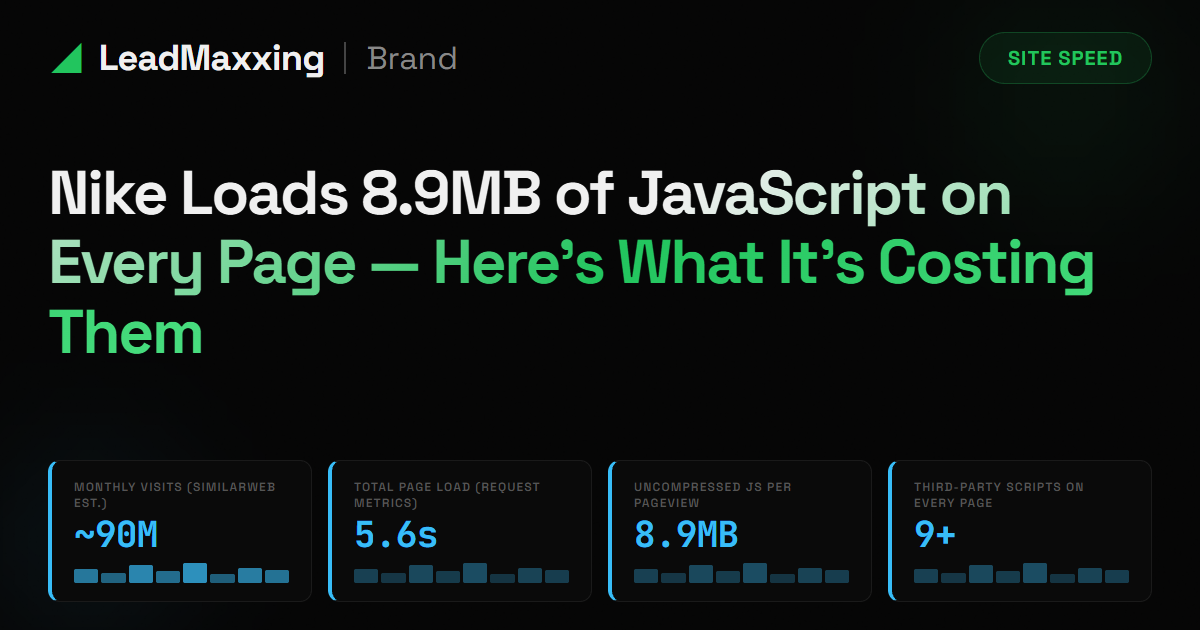
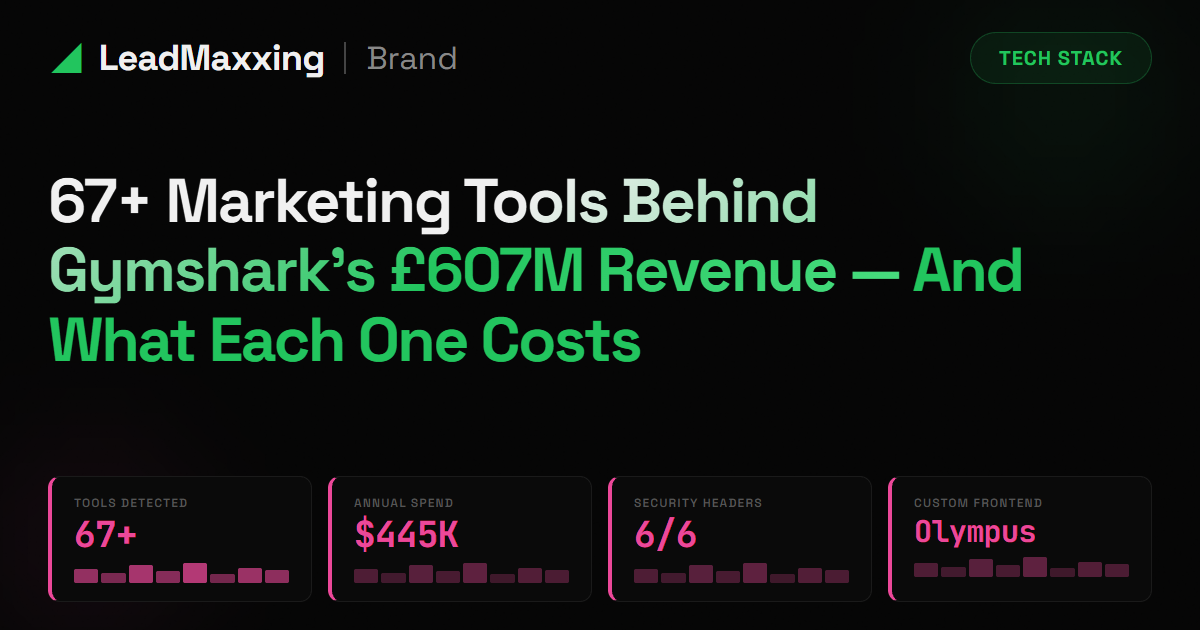
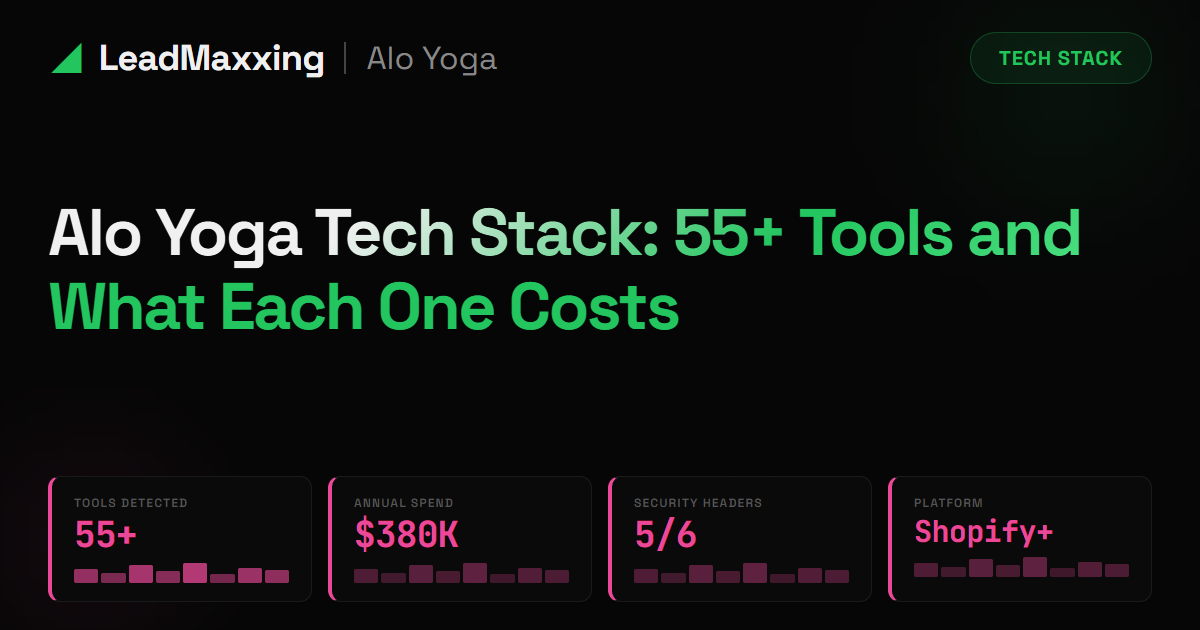
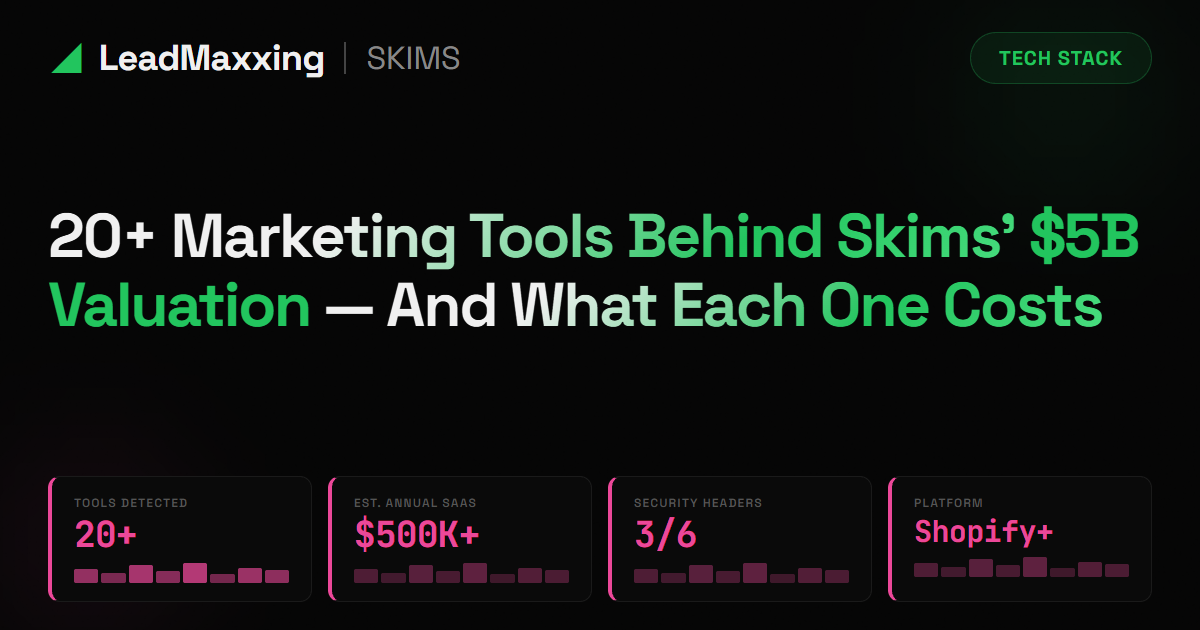
Tech Stack & Security for Similar Brands
Sources & References
w3techs.com
investors.nike.com
medium.com/nikeengineering
builtwith.com
securityheaders.com
ev-cn.nike.com.edgekey.net.
netify.ai
curl -sI https://www.nike.com to verify.
developer.mozilla.org
Frequently Asked Questions
What CDN does Nike use?
ev-cn.nike.com.edgekey.net. Akamai's Enhanced TLS network (edgekey.net) provides enterprise-grade content delivery with edge computing capabilities. At Nike's global traffic volume, Akamai CDN costs are estimated in the millions annually.