Fabletics Spends $40M+ on Tech — Here's Every Script Behind Their $1B VIP Machine
We audited every script, CDN, and optimization on fabletics.com — how a custom React + Node.js stack behind Cloudflare powers 2.7 million VIP members.
served by platform
(2025, verified)
investment
330+ edge locations
First: Why Should You Care About Site Speed?
Hard revenue data from Google, Portent, and Deloitte that proves speed is money
Because every second costs you real money. This isn't a vanity metric. Google, Deloitte, and Akamai have all studied this, and the numbers are brutal:
Sites loading in 1 second have 5x higher conversion rates than sites loading in 10 seconds. Not 5% more. Five times more.
Bounce rate increases 90% when load time goes from 1 second to 5 seconds. Nine out of ten people who would've stayed on your site just... leave.
A 0.1-second improvement in mobile speed = 8.4% more conversions in ecommerce. That's not a typo. One tenth of a second. Google measured this across real retail sites.
Fabletics gets this. That's why TechStyle Fashion Group invested $40M+ annually in technology infrastructure, including building a fully custom e-commerce platform rather than relying on off-the-shelf solutions like Shopify. When you're running a VIP membership model with 2.7 million paying members, every millisecond of friction between "I want this" and "checkout complete" is money left on the table.
Speed gets visitors to the page. But do you know who they are? LeadMaxxing identifies your anonymous visitors and scores them so you know which ones are worth chasing.
Core Web Vitals: The 3 Numbers Google Actually Uses to Rank You
LCP, INP, and CLS explained with Fabletics's real field data
Google doesn't care about your Lighthouse score. Seriously. Lighthouse is a lab test — it's a simulation. What Google actually uses for rankings are Core Web Vitals: real data from real Chrome users visiting your real site over the last 28 days. Three numbers:
| Metric | Plain English | Good | Bad | Why It Matters |
|---|---|---|---|---|
| LCP | How fast the main content appears | < 2.5s | > 4.0s | Users see a blank screen until LCP fires. Slow LCP = they leave before seeing your product. |
| INP | How fast buttons & clicks respond | < 200ms | > 500ms | 43% of sites fail this in 2026. When "Add to Cart" feels laggy, people don't add to cart. |
| CLS | How much the page jumps around | < 0.1 | > 0.25 | Ever try to tap a button and the page shifts so you hit the wrong thing? That's CLS. Users hate it. |
Users are 24% less likely to abandon a page when it passes all three. That's the difference between a $1M/year store and a $1.24M/year store — from metrics alone. Core Web Vitals are also a confirmed SEO ranking signal, which means slow sites lose twice: visitors leave AND Google ranks you lower.
For Fabletics, this matters even more than most brands. Their VIP membership model means returning members need fast, frictionless access to new collections and their account dashboards. Fabletics runs on Cloudflare's CDN with 330+ edge locations — so static assets are cached close to users globally. However, their multiple analytics scripts (Google Analytics, Adobe Analytics, and Mixpanel all running simultaneously) add significant JavaScript overhead that impacts lab scores.
Run a live PageSpeed test on fabletics.com right now → — you'll see their real CrUX field data.
Think of it like a restaurant. LCP is how fast the food arrives. INP is how quickly the waiter responds when you flag them down. CLS is whether your plate slides off the table while you're eating. Google measures all three for every visitor, and if your site fails, it ranks lower. Period.
Why Fabletics Built a Custom Platform From Scratch
How TechStyle Fashion Group's $40M+ tech investment powers a VIP-first architecture
Most DTC brands use Shopify. Fabletics didn't. When you're running a VIP membership model where 80% of customers and 95% of revenue come from recurring members, no off-the-shelf platform handles the complexity. Fabletics needed custom pricing tiers, personalized member dashboards, skip-the-month flows, and real-time inventory synced across 114+ retail stores and e-commerce — all at once.
So TechStyle Fashion Group built their own. A fully custom e-commerce platform with React + Next.js on the frontend, Node.js on the backend, and Builder.io as the headless CMS. Their CTO Tim Collins told Whitespectre that the Builder.io migration alone made workflows "75% more efficient" and saved 20% of their dev budget. Here's how the architecture flows:
What "Custom Platform" Means (Without the Jargon)
Shopify store: Shopify handles everything — your pages, your cart, your checkout, your product data. It's fast to set up, but you're limited to what Shopify allows. Try building a "skip the month" VIP flow or syncing membership pricing across 114 physical stores, and you'll hit walls fast.
Fabletics' custom setup: They built the entire commerce engine themselves. The frontend (what you see) runs React and Next.js. The backend (business logic, VIP tiers, inventory) runs Node.js. Content editors use Builder.io to update marketing pages without touching code. Cloudflare sits in front of everything, caching static assets and blocking attacks. (We break down their full tech stack and security headers in a separate report.)
The result? Complete control over every aspect of the VIP member experience, from personalized pricing to cross-channel inventory management across e-commerce and 114+ retail locations.
Almost certainly not. Fabletics' custom approach makes sense because they're a $1B+ brand with a complex VIP membership model, 114+ stores, and a parent company (TechStyle) that runs multiple fashion brands on shared infrastructure. If you're under $50M, Shopify Plus gives you 90% of the functionality at a fraction of the cost and complexity. The real takeaway: Fabletics proves that the platform choice should follow the business model, not the other way around.
The 8 Scripts Adding JavaScript Weight to Every Fabletics Pageview
Multiple analytics platforms, search tools, and marketing scripts on every page load
Here's the tradeoff Fabletics makes: data richness over raw speed. They run three separate analytics platforms simultaneously — Google Analytics, Adobe Analytics, and Mixpanel — which is unusual and expensive in JavaScript terms. Most brands pick one. Fabletics loads all three on every page, plus tag management, search, and marketing scripts. (See our full tracking and cookie audit for the complete picture of what runs on every pageview.)
Fabletics runs three analytics platforms because their VIP model demands it. Adobe Analytics handles attribution and marketing mix modeling. Google Analytics provides the Google ecosystem integration. Mixpanel powers their product analytics and user identification. Could they consolidate? Probably. But when 95% of revenue comes from VIP members, the granularity of understanding why members stay, skip, or cancel is worth more than 25 Lighthouse points. If you're under $10M/year, you almost certainly don't need three analytics platforms — one is enough.
Fabletics needs 8+ disconnected tools to track their VIP funnel. LeadMaxxing combines visitor tracking, lead scoring, email automation, and A/B testing in one script — so you don't need to stack tools and tank your PageSpeed.
How Fabletics Serves Images Through Cloudflare's Edge
CDN-level caching, Builder.io optimized delivery, and React-powered lazy loading
Images are typically 50-70% of total page weight on an ecommerce site. Fabletics runs their entire image pipeline through Cloudflare's CDN, which means product images, hero banners, and marketing assets are all cached at 330+ edge locations worldwide. Builder.io adds its own image optimization layer for editorial content:
The Simple Stuff You Can Copy Today
- Switch every image to WebP. If you're still serving JPEGs, you're wasting 30% of your bandwidth. Most CDNs (including Cloudflare) can do this automatically.
- Add
loading="lazy"to every image below the fold. One HTML attribute. Stops the browser from downloading images the user hasn't scrolled to yet. - Set explicit width and height on images. This prevents CLS (layout shift). The browser reserves space before the image loads, so nothing jumps around.
- Use responsive images. A phone doesn't need the 2000px desktop version. Use
srcsetto serve the right size for each device.
How Speed and Search Drove 102% Revenue Growth
Per Athos Commerce's Fabletics case study, search optimization drove major commercial gains
This isn't theoretical. Per Athos Commerce's published case study, Fabletics' investment in search performance and site experience drove measurable commercial results. Separately, Taggstar reported that social proof implementation generated a 3.19% conversion rate uplift. Here's what was reported:
| What Changed | Before | After | Revenue Impact |
|---|---|---|---|
| Site search (Athos Commerce) | Previous search platform | Athos Commerce / SearchSpring | 102% search revenue growth |
| Average order value | Baseline AOV | Optimized merchandising | 21% increase over 2 years |
| Social proof (Taggstar) | No social proof | Real-time social proof messaging | 3.19% conversion uplift |
| CMS migration (Builder.io) | Legacy CMS | Builder.io headless CMS | 75% more efficient workflows, 20% dev savings |
Sources: Per Athos Commerce, Taggstar, and Whitespectre/Builder.io published case studies. Figures as reported by vendors.
Speed and search are the same problem. Fabletics' 102% search revenue growth came from making product discovery faster and more relevant. When a VIP member lands on fabletics.com and instantly finds what they're looking for, they convert. When they wait, they cancel their membership. That's why Fabletics invested in Athos Commerce for search and Builder.io for content velocity — speed isn't just about load times, it's about how fast the customer gets to "yes."
Curious what your own speed-to-revenue ratio looks like? LeadMaxxing tracks every visitor session — including time-on-site, scroll depth, and conversion events — so you can see exactly which pages are fast enough to convert and which ones are leaking money.
Key Findings
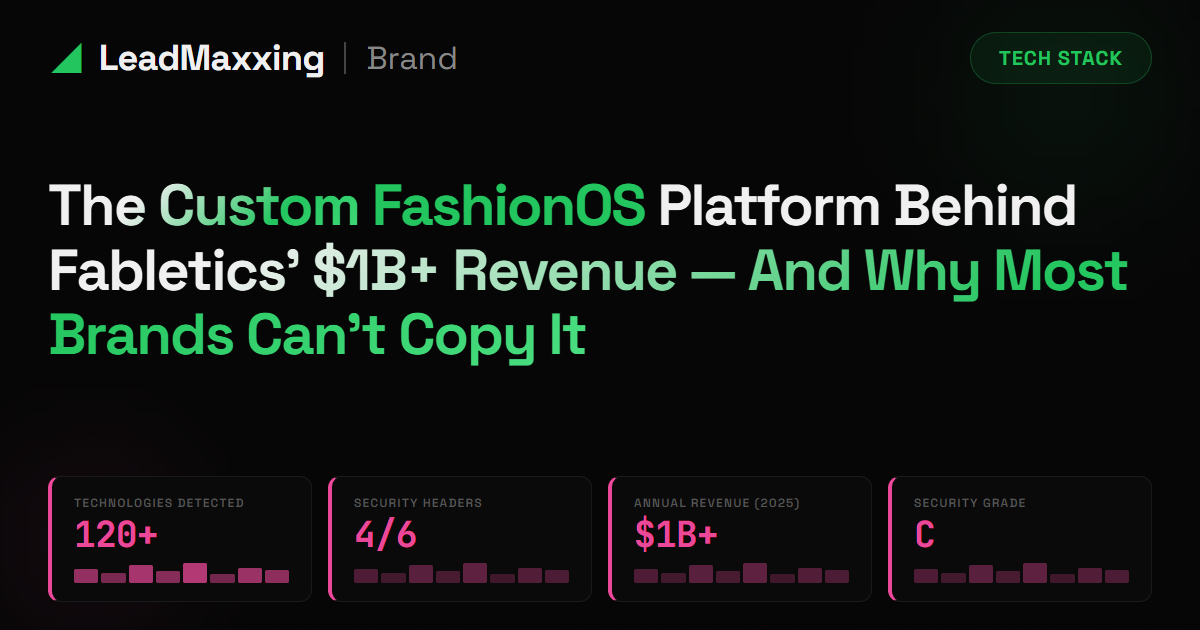
- → Fabletics runs a fully custom e-commerce platform (not Shopify) built by TechStyle Fashion Group, powered by React + Next.js frontend and Node.js backend, backed by $40M+ in annual technology investment (per Glossy)
- → Three separate analytics platforms (Google Analytics, Adobe Analytics, and Mixpanel) run simultaneously on every pageview, adding an estimated ~210KB of JavaScript — more than most brands' entire third-party script budget
- → Cloudflare CDN with 330+ global edge locations provides caching, DDoS protection, and WAF for all 2.7 million VIP members (confirmed via DNS analysis: A records 104.18.42.9 and 172.64.145.247)
- → 102% search revenue growth after implementing Athos Commerce (formerly SearchSpring) for site search, plus 21% AOV increase over two years (per Athos Commerce case study)
- → Builder.io headless CMS migration made content workflows "75% more efficient" and saved 20% of dev budget (per Whitespectre case study, CTO Tim Collins)
What This Data Means for You
Turning Fabletics' site speed strategy into your competitive advantage
Fabletics' speed story proves that performance investment must match business complexity. Their custom platform, triple-analytics stack, and Builder.io CMS exist because their VIP membership model demands it. But you don't need their $40M tech budget to get fast. The biggest wins come from basics like image optimization, script auditing, and picking the right CDN. Their ad landing pages, email campaigns, and VIP pricing flows all depend on the speed infrastructure we've analyzed here. The 20% of effort that gets you 80% of their speed is accessible to any brand at any scale.
LeadMaxxing Automates This Site Speed Playbook
Fabletics runs 8+ scripts to track their VIP member journey. LeadMaxxing gives you AI-powered visitor identification, lead scoring, and automated email campaigns for $29/month — the same conversion intelligence without the enterprise complexity or the PageSpeed penalty.
See how it works →5 Things You Can Implement Today
Actionable lessons from Fabletics' site speed playbook
You don't need Fabletics' budget. Here's the 20% of effort that gets you 80% of their speed:
Run PageSpeed Insights
Takes 5 minutes. Run your site through PageSpeed Insights. The "Opportunities" section tells you exactly what to fix. Free. This is especially critical for ad landing pages where every fraction of a second impacts your ROAS. LeadMaxxing can automate this for every competitor you track.
Audit Third-Party Scripts
Takes 1 hour. Open Chrome DevTools, Network tab, filter by JS. Count scripts from external domains. Fabletics runs 3 analytics platforms — you probably only need one. Every removed script saves 30-90KB. LeadMaxxing replaces multiple tools with one lightweight script.
Optimize Images
Takes 1 day. Convert to WebP, add lazy loading, set explicit dimensions. Drops page weight by 40-60%. Cloudflare (which Fabletics uses) offers automatic image optimization on their Pro plan. LeadMaxxing monitors competitor image strategies so you can benchmark against the best.
Monitor Real User Data
Ongoing. Check Search Console Core Web Vitals monthly. Lab scores fluctuate wildly; field data (CrUX) is what Google actually uses. LeadMaxxing tracks visitor experience metrics alongside conversion data.
Supercharge Your Leads with LeadMaxxing
Get a free LeadMaxxing account and start supercharging your leads. Start free →
Get This Analysis For Your Brand FREE
When You Create A Free LeadMaxxing Account
Create a free LeadMaxxing account and we'll generate a full competitive analysis for YOUR brand. The same intelligence you just read — comparison with competitors, actionable strategies, and AI-powered recommendations.
More Fabletics Intelligence
Site Speed Audits for Similar Brands
Frequently Asked Questions
How fast is Fabletics' website?
What tech stack does Fabletics use?
Does Fabletics use Shopify?
What CDN does Fabletics use?
What third-party scripts does Fabletics load?
How does Fabletics' site speed compare to competitors?
What is Fabletics' image optimization strategy?
How does Fabletics handle high-traffic events?
Sources & References
whitespectre.com
athoscommerce.com
taggstar.com
pagespeed.web.dev
sgbonline.com
glossy.co
developer.chrome.com/docs/crux
builtwith.com